There is a meal (or really, many meals) my grandmother made for special occasions. She never wrote the recipe for it down. She made it from memory, the way she made everything, measuring nothing, adjusting as she went, and it tasted exactly right every single time. When she died, the meal went with her.
We have tried to recreate it. My mom has a version that is close. I have a version that is close in a different way. But neither of us has the real thing, and we never will, because no one thought to sit down with her and write it down while we still could.
That is the loss that lives inside a lot of families. Not just the recipe itself, but the ritual around it. The smell of it. The way it meant something was coming or something was being marked.
You have the chance to do something about that for your family right now. Not someday. Now, while the people who hold the recipes are still here, and while your kids are still young enough that the traditions you build this year will be the ones they carry for the rest of their lives.
This post is about how to do that.
What Makes a Recipe a Tradition
Not every recipe becomes a tradition. Most of them are just dinner.
The ones that become traditions share a few things in common. They are tied to a specific time – a season, a holiday, a Sunday, a birthday. They are made repeatedly, not just once. And they carry a feeling that goes beyond the food itself. The taste of them means something. It says: this time of year has arrived, or this family is gathered, or this is what we do.
Think about the recipes that already function this way in your home, even informally. The thing you make every Thanksgiving that someone would notice if it was missing. The soup that only gets made when it gets cold. The birthday cake that is always the same because that is the one. Those are your traditions. You may not have been calling them that, but that is what they are.
The goal is to do two things: capture the ones you already have before they get lost, and intentionally build new ones so that your kids grow up with a full repertoire of food memories that belong specifically to your family.

The Seasonal Recipe Framework
The easiest way to build a family recipe collection with meaning is to organize it around the seasons. Not because you have to be precious about it, but because seasonal cooking is naturally the way food becomes memorable. The tomato salad you make in August when tomatoes are actually good. The apple crisp that only exists in October. The stew that means it is finally cold enough to have the oven on all afternoon.
When you tie a recipe to a season, it becomes an event. You do not make it all year. You wait for it. And the waiting is part of what makes it feel like something.
Here is a simple framework for thinking about it:
One signature dish per season. Not a new recipe every week. One dish per season that becomes your family’s taste of that time of year. You make it every year until your kids request it by name. It does not have to be complicated. It has to be repeatable and it has to be yours.
Some ideas to get you started:
Spring: A simple pasta with asparagus and lemon. A spring vegetable frittata with whatever is fresh at the market. Strawberry shortcake made from scratch, once, every May, with the first good strawberries of the season.
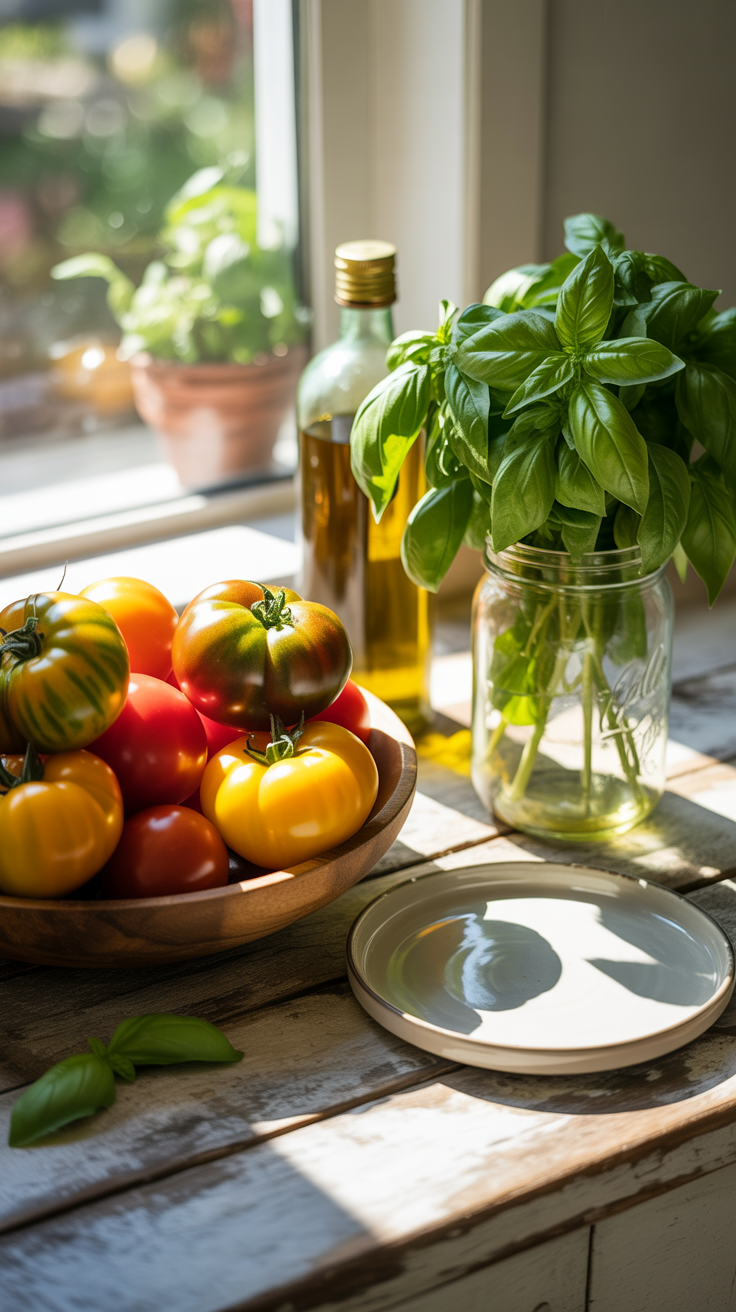
Summer: A tomato salad that only gets made when tomatoes are actually at peak — not hothouse, not January, not good enough. The real ones, in August, with good olive oil and salt and nothing else trying too hard. Grilled corn with butter and lime. A berry crisp or cobbler with whatever is overflowing at the market.
Autumn: A big pot of soup on the first genuinely cold Sunday. An apple cake or apple crisp that makes the house smell like the season. A roast chicken with root vegetables that becomes the Sunday dinner from September through November.
Winter: A slow-cooked stew or braise that simmers all afternoon on a Saturday. A holiday cookie that only gets made in December, the same one every year, with your kids standing on chairs at the counter. A cozy soup that comes out in January and signals that the reset after the holidays has officially begun.
One special occasion meal per season. Each season gets one meal that is slightly more than ordinary. Not a dinner party. Not a production. Just a meal where you set the table properly, light a candle, and make something that feels a little special.
Spring: A Saturday lunch that feels fresh and intentional — a big composed grain salad with roasted asparagus, fresh peas, and a bright lemon vinaigrette alongside bruschetta with ricotta and fresh herbs. The table set with whatever is blooming outside in a small vase.
Summer: A backyard dinner after the sun goes down, with your family’s favorite summer meal. Paper plates are fine. The food matters less than the fact that everyone is outside together.
Autumn: A Sunday roast on the first cold weekend of the season. Everyone home, the oven on, the house smelling like dinner all afternoon.
Winter: A candlelit soup night in January. Every bowl different, bread on the side, candles on the table. The simplest meal of the year and somehow always one of the most memorable.

How to Actually Build the Collection
Having the framework is one thing. Actually capturing the recipes and building something that lasts is another. Here is how to do it in a way that is sustainable rather than overwhelming.
Start with what you already make. Do not start by looking for new recipes. Start by writing down the ones you already make from memory or habit. The things you cook without thinking. The family favorites that live in your head. These are the most at risk of being lost because they are the ones that have never been written down.
Set aside one hour. Sit down with a notebook or your phone and write down every recipe you make regularly from memory. Just the name and the basic steps. You can refine it later. The first goal is capture.
Ask the people who hold the recipes. If you have a parent, grandparent, aunt, or family friend who makes something you love and do not know how to make, call them this week and ask them to walk you through it. Record the call if you can. Write it down while they talk. Ask about the details that never make it into a written recipe — how they know when it is done, what they do differently from the original, what the trick is.
Do not wait for the right moment to do this. The right moment is now.
Let produce lead you to new ones. One of the best ways to discover recipes that will become seasonal traditions is to start with what is in season and work backward. Walk through the produce section and buy what looks best. Then find a simple preparation for it. Do that a few times each season and you will naturally land on the ones worth repeating.
The recipes that become traditions are rarely the complicated ones. They are usually the simple ones that just taste like that season and nothing else.
Make it once, then make it again. A recipe becomes a tradition through repetition, not intention. You cannot declare something a tradition. You just have to make it again next year. And the year after that. Eventually it will be the thing your family asks for, and that is when you know it has arrived.
How to Preserve What You Collect
Once you start capturing recipes, you need somewhere to put them that is not a pile of screenshots and index cards that will get lost or thrown away.
The options range from simple to more involved, but the most important thing is that it works for you and that you will actually use it.
A dedicated notebook. The lowest-friction option. A hardcover notebook kept in the kitchen where you write recipes down by hand, with notes about when you made them and what you adjusted. This is the one that feels most like an heirloom because it will have your actual handwriting in it. Your kids will be able to read it someday and it will feel like something.
A recipe binder by season. A simple three-ring binder organized into four sections — spring, summer, autumn, winter — with printed or handwritten recipes in each section. Add a page at the front of each section for notes on what worked and what to try next. This is the easiest to browse and update.
A digital collection with printed backups. Apps like Paprika or a simple Google Doc organized by season work well if you cook from your phone or want to share easily. The key is to print the ones that matter and keep a physical copy somewhere, because digital collections have a way of disappearing or becoming inaccessible.
A proper recipe journal. A dedicated, beautiful journal where each recipe gets its own page with the recipe itself, the story behind it, and space to note when you made it and for what occasion. This is the version that becomes the heirloom.
Whatever format you choose, make sure each recipe includes a few things beyond just the ingredients and steps: where it came from, when you make it, and what it means. Even one sentence. “This is the apple crisp I started making the autumn after we moved into this house. It smells like October.” That sentence is worth more than the recipe itself.
The Recipe Your Family Will Ask For Forever
Here is the truth about the recipe that becomes the one: you probably will not know it is that recipe when you first make it.
You will make something on a Saturday in October because you had apples that needed using. It will turn out well. You will make it again the following October because you remembered it was good. Your kid will ask for it in September because they remembered it from last year. You will make it every autumn for the next ten years, adjusting it slightly each time, until it is yours in a way that no recipe from the internet can be.
That is how it happens. Not through searching for the perfect recipe. Through making something, liking it, and making it again.
The collection you are building is not a database of good food. It is a record of the meals that meant something. The ones that said this season has arrived, or this family is together, or this is what we do. The ones your kids will try to recreate someday and come close but not quite get right, and then pass down to their own kids with the same imprecision and the same love.
That is what you are building. Start this week.


Leave a Reply